

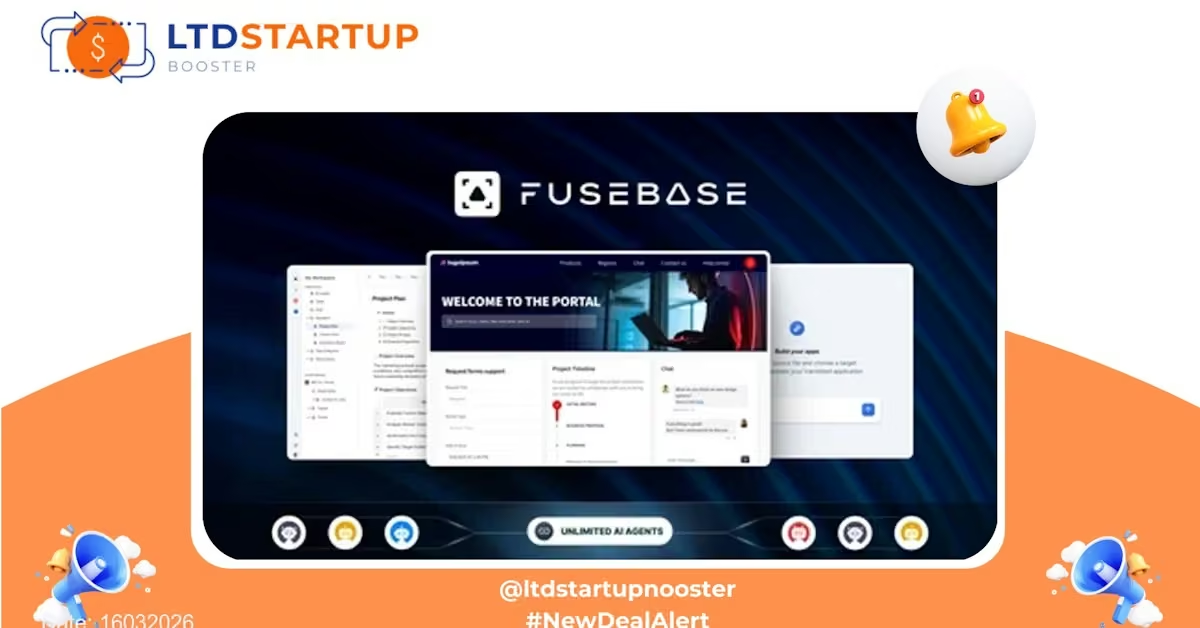
FuseBase: Turn Your Documents into Instant, Searchable Knowledge — Lifetime Deal Spotlight
FuseBase is a focused platform for building fast, semantic search and knowledge-base experiences from documents, web pages and internal content. This lifetime deal gives companies and teams one-time access to FuseBase’s core capabilities — simplifying how you ingest, embed, index and retrieve information for customer support, internal wikis, sales enablement, and product documentation.
Introduction — What the lifetime deal includes
The FuseBase lifetime deal is designed to help startups, small teams, and independent creators get immediate access to a production-ready semantic search stack without recurring fees. The offer bundles the core FuseBase platform — document ingestion, automatic embeddings, a hosted vector index, search UI templates, and developer APIs — under a single, lifetime license tier. Published: 16032026. Note that this is a limited allocation offer and the deal will close once the available units are sold out.
Key Features — What makes FuseBase useful
- Universal document ingestion: Upload and sync PDFs, Word docs, Markdown, CSVs, and web pages. FuseBase typically extracts text, metadata and structure so content is searchable right away.
- Automatic embeddings & semantic search: Built-in embedding pipelines convert content into vector representations so you can search by meaning, not just keywords. This improves recall for paraphrased questions and concept-based queries.
- Hosted vector index: A managed vector database and retrieval layer eliminates setup overhead — FuseBase handles indexing, sharding and query serving so teams can focus on apps, not ops.
- Ready-made UI templates: Prebuilt search interfaces and chat-style knowledge explorers let you deploy a polished experience quickly with minimal front-end work.
- APIs & SDKs: Developer-friendly REST and SDK options let you integrate FuseBase into websites, help desks, chatbots and internal tools.
- Connectors & integrations: Native connectors for common content sources (drive folders, CMS exports, and web crawling) speed ingestion workflows and keep indexes fresh.
- Usage analytics & tuning: Search analytics, relevance tuning and logs help you monitor coverage, search satisfaction and performance as content evolves.
Use Cases — Real-world ways to apply FuseBase
- Customer support: Power a searchable knowledge base so agents and customers can find solutions quickly. Use semantic search to surface the right help article even when customers phrase questions differently.
- Internal knowledge & onboarding: Aggregate product docs, SOPs and training materials into a single searchable layer to speed ramp-up for new hires.
- Developer & product docs: Let engineers and power users query API docs, design specs and change logs to find examples and relevant snippets in seconds.
- Sales enablement: Give reps quick access to product collateral, pricing sheets and competitive notes when researching leads or preparing proposals.
- Research & discovery: Index long-form reports, transcripts and academic materials to accelerate insights and cross-document search during analysis.
Comparison — How FuseBase stacks up against other tools
Below is a practical comparison focused on position and strengths. Competitors in this space include Pinecone, Qdrant, Milvus, Algolia and Elastic. Each has strengths; here’s where FuseBase differentiates itself:
| Capability | FuseBase (lifetime offer) | Typical competitors |
|---|---|---|
| Ease of getting started | All-in-one onboarding with ingestion tools and UI templates for fast deployments. | Vector DBs like Pinecone/Qdrant require more wiring and front-end work. |
| Managed vs DIY | Managed hosting and index maintenance included, reducing operational overhead. | Some options focus purely on the vector engine and expect you to handle hosting and ingestion. |
| Search experience | Built-in semantic search and conversational UI templates aimed at end-user applications. | Search platforms such as Algolia/Elastic excel at keyword search and ranking; semantic layers need extra integration. |
| Developer tooling | APIs and SDKs plus prebuilt templates to accelerate integration. | Vector DBs provide powerful APIs but fewer opinionated UI components out-of-the-box. |
| Cost model | Lifetime deal reduces long-term recurring cost risk for teams that want predictable pricing. | Most professional services are subscription-based, scaling with usage. |
Pricing Table — FuseBase AppSumo Lifetime Deal Tiers
Below is a summary of the main pricing tiers from the FuseBase AppSumo lifetime deal. This table outlines user limits, workspace capacities, storage, and AI agent counts included per tier.
| Tier | Price (One-time) | Users | Workspaces | Storage | AI Agents |
|---|---|---|---|---|---|
| 1 Code | $79 | 1 | 50 | 50 GB | 5 |
| 2 Codes | $158 | 3 | 100 | 100 GB | 8 |
| 3 Codes | $237 | 10 | 200 | 400 GB | 20 |
| 4 Codes | $316 | 12 | 250 | 450 GB | 25 |
For the complete and official pricing details, including additional features and limitations per plan, please visit the FuseBase AppSumo product page directly.
Security & Compliance — Data protection and controls
Security is a core consideration when you centralize company knowledge. FuseBase typically implements standard protections such as TLS for data in transit, encryption at rest, role-based access controls (RBAC), and routine backups. The platform is designed to let teams control data ingestion scope, access permissions and export options.
For regulated environments, confirm specifics with the provider — such as data residency options, SOC 2 attestation, or specific GDPR controls — before moving sensitive data into production. If you require on-premise or private-cloud deployment, check whether self-hosting or dedicated instances are offered in your plan.
Want to learn more before you buy? Click the button above to view full deal details, plan limits, and frequently asked questions on the deal page. Deals like this move quickly — act before the allocation sells out.